
台星科 RBA 驗證性評估計畫證書Winstek RBA Validated Assessment Program Certificate
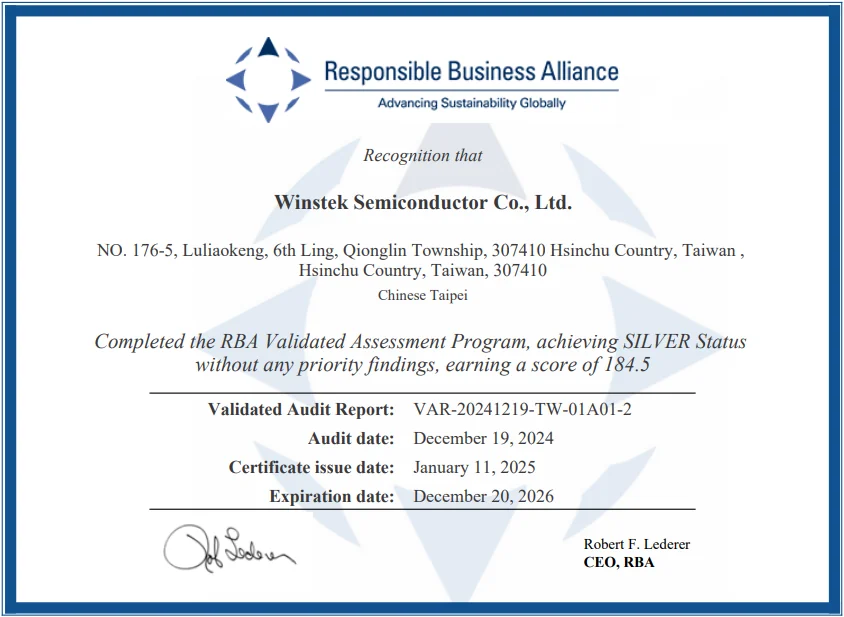
責任商業聯盟(RBA)行為準則旨在建立標準,以確保供應鏈中的工作環境安全,業務以負責任、合乎道德的方式執行,並尊重人權及環境。The Responsible Business Alliance (RBA) Code of Conduct establishes standards that seek to promote that working conditions in supply chains are safe, and that business is conducted responsibly, ethically, and with respect for human rights and the environment.
任何企業都可以自願採用本準則,並相應應用到其直接及間接的供應鏈和外包商中,包括提供合同工的供應商。The Code may be voluntarily adopted by any business and subsequently applied by that business to its direct and indirect supply chain and subcontractors, including providers of contract labor.
要採用本準則並成為其中的參與者(下稱「參與者」),企業應當作出支持本準則的聲明,並透過建立有效的管理體系,按照本準則及其標準進行盡職調查。To adopt the Code and become a participant ("Participant"), a business shall declare its support for the Code and conduct due diligence in line with the Code and its standards through the establishment of an effective management system.
參與者必須在其整個供應鏈中倡議採用本準則。至少,參與者應要求他們下一級供應商認同並落實執行本準則。While it is recommended to review the Code as a total Supply Chain Initiative, at a minimum, participants should require their next tier suppliers to acknowledge and implement the code.
企業採用本準則的基本原則為其所有商業經營活動都必須完全遵守其經營所在國家適用的法律、法例及法規1。為符合本文件參考資料中列出的國際公認標準,並利用全球供應鏈的最佳實務,本準則的要素可能超出法律合規性,以促進社會和環境責任及商業道德。在任何情況下,遵守本準則不會違反適用的法律。但是,如果 RBA 準則與適用法律之間存在不同標準,則 RBA 將遵循定義為滿足最嚴格的要求。Fundamental to adopting the Code is the understanding that a business, in all of its activities, must operate in full compliance with applicable laws, rules, and regulations1. In alignment with internationally recognized standards as listed under the References of this document, and drawing upon best practices in global supply chains, elements of this Code may go beyond legal compliance in order to advance social and environmental responsibility and business ethics. In no case can complying with the Code violate applicable laws. If, however, there are differing standards between the RBA Code and applicable laws, the RBA defines conformance as meeting the strictest requirements.
本守則的條款源自並尊重國際認可的標準,當中包括:The provisions of this Code are derived from and respect internationally recognized standards including:
- 經合組織跨國企業準則OECD Guidelines for Multinational Enterprises
- 《聯合國商業和人權指導原則》UN Guiding Principles on Business and Human Rights
- 《ILO 工作基本原則與權利聲明》ILO Declaration on Fundamental Principles and Rights at Work
- 《ILO 基本公約》ILO Fundamental Conventions
- 聯合國世界人權宣言UN Universal Declaration of Human Rights
本準則由五個部分組成:The Code is made up of five sections:
- 第 A、B 及 C 節:勞工、健康與安全,以及環境的標準。Sections A, B, and C: Standards for Labor, Health and Safety, and the Environment, respectively.
- 第 D 節:商業道德標準。Section D: Standards relating to business ethics.
- 第 E 節:用於管理本準則合規性的可接受系統的要素。Section E: Elements of an acceptable system to manage conformity to this Code.
RBA 承諾會在持續發展和實施《行為準則》的過程中定期收集持份者的反饋。The RBA is committed to obtaining regular input from stakeholders in the continued development and implementation of the Code of Conduct.
參與者承諾尊重工人的人權,並令他們有尊嚴。這適用於所有直接和間接供應商,以及所有的工人,包括臨時工、移民工、學生、合約勞工、直接僱員以及任何其他類型的勞工。勞工標準如下:Participants commit to respect the human rights of workers, and to treat them with dignity. This applies to direct and indirect suppliers, as well as all workers including temporary, migrant, student, contract, direct employees, and any other type of worker. The labor standards are as follows:
不允許任何形式的強迫勞動,包括但不限於債役(包括債役)或契約勞工、非自願或剝削性監獄勞工、奴役或人口販運。這包括為了得到工作或服務而使用恐嚇、強迫、威脅、綁架或詐騙手段來運送、窩藏、招募、調配或接收勞工。除了禁止對工人出入工作場所作出不合理限制外,也不應無理地約束工人在工作場所內的行動自由,適用時包括工人宿舍或生活住所。作為招聘程序中的必要部份,必須為所有工人提供其母語或工人可以理解的語言的書面僱傭協議,並且在協議中描述僱傭條款和條件。必須在海外移民工人離開原本的國家前,為其提供僱傭協議;而在其抵達接收國家後,該僱傭協議不得有任何替換或更改,除非有關更改是為了符合當地法律的要求和提供相同或更佳條件而作出例外。所有工作應出於自願,若發出合理通知,工人可以隨時離開工作或終止僱傭關係,而不會受到處罰,並應在工人合約中明確規定。參與者應保存所有離職員工的文件。僱主、中介人及二級中介人不得扣留或以其他方式毀壞、隱藏、沒收員工的身份證或出入證證件,比如政府頒發的身份證明、護照或工作許可證。儘管有上述規定,僱主僅可在遵守當地法律所需的情況下保留文件。就算是在此情況下,任何時候也不可拒絕工人取用其文件。不得要求工人繳付僱主的中介人或二級中介人的招聘費用或其他與其聘用相關的費用。如發現勞工繳付了任何該等費用,該等費用須退還予相關勞工。Forced labor in any form, including but not limited to, bonded (including debt bondage) or indentured labor, involuntary or exploitative prison labor, slavery or trafficking of persons is not permitted. This includes transporting, harboring, recruiting, transferring, or receiving persons by means of threat, force, coercion, abduction or fraud for labor or services. There shall be no unreasonable restrictions on workers' freedom of movement in the facility in addition to unreasonable restrictions on entering or exiting company-provided facilities including, if applicable, workers' dormitories or living quarters. As part of the hiring process, all workers must be provided with a written employment agreement in their native language, or in a language the worker can understand, that contains a description of terms and conditions of employment. Foreign migrant workers must receive the employment agreement prior to the worker departing from his or her country of origin and there shall be no substitution or change(s) allowed in the employment agreement upon arrival in the receiving country unless these changes are made to meet local law and provide equal or better terms. All work shall be voluntary, and workers shall be free to leave work at any time or terminate their employment without penalty if reasonable notice is given, which shall be clearly stated in workers' contracts. Participants shall maintain documentation on all leaving workers. Employers, agents, and sub-agents' may not hold or otherwise destroy, conceal, or confiscate identity or immigration documents, such as government-issued identification, passports, or work permits. Notwithstanding the foregoing, employers can only hold documentation if necessary to comply with the local law. In this case, at no time shall workers be denied access to their documents. Workers shall not be required to pay employers' agents or sub-agents' recruitment fees or other related fees for their employment. If any such fees are found to have been paid by workers, such fees shall be repaid to the worker.
不得在任何製造工序中使用童工。「童工」指僱任何未滿 15 歲、或未達強迫教育年齡、或該國家/地區最低就業年齡的人士(三項中取年齡最大者)。未滿 18 歲的勞工(年輕勞工)不得從事可能會危及其健康和安全的工作,包括夜班或加班。參與者應適當保管學生記錄、嚴格審核教育合作夥伴,以及按照適用的法例保障學生的權利,從而確保對學生的管理得當。參與者應採取適當的機制核實員工的年齡。符合所有法例與法規的合法職學習計劃則不在此列。參與者應為所有學習生提供適當的支持和培訓。如果沒有當地法律規管,學生、實習生和學徒的薪水應最少與從事同等或相似工作的其他入門級員工相等。如發現童工,我們將提供協助/補救措施。Child labor shall not be used in any stage of manufacturing. The term "child" refers to any person under the age of 15, or under the age for completing compulsory education, or under the minimum age for employment in the country, whichever is greatest. Workers under the age of 18 (Young Workers) shall not perform work that is likely to jeopardize their health or safety, including night shifts and overtime. Participants shall ensure proper management of student workers through proper maintenance of student records, rigorous due diligence of educational partners, and protection of students' rights in accordance with applicable laws and regulations. Participants shall implement an appropriate mechanism to verify the age of workers. The use of legitimate workplace learning programs, which comply with all laws and regulations, is supported. Participants shall provide appropriate support and training to all student workers. In the absence of local law, the wage rate for student workers, interns, and apprentices shall be at least the same wage rate as other entry-level workers performing equal or similar tasks. If child labor is identified, assistance/remediation shall be provided.
工作時數不應超過當地法律規定的最大限度。此外,每週的工作時數不應超過 60 小時(包括加班),緊急或特殊情況除外。所有加班均屬自願性質。每七天應當允許勞工至少休息一天。Working hours shall not exceed the maximum set by local law. Further, a workweek shall not be more than 60 hours per week, including overtime, except in emergency or unusual situations. All overtime shall be voluntary. Workers shall be allowed at least one day off every seven days.
支付給勞工的工資應符合所有相關的薪酬法律,包括有關最低工資、加班和法定福利的法律。所有員工應獲得平等工作與資格的同等薪酬。勞工的加班工資應高於常規時薪水平。禁止以扣工資作為紀律處分的手段。在每個支薪期,應及時為勞工提供簡明的工資單據,內含充足的資料證實支付給勞工的薪酬準確無誤。必須按照當地法律聘用臨時工、派遣員和外判工人。Compensation paid to workers shall comply with all applicable wage laws, including those relating to minimum wages, overtime hours and legally mandated benefits. All workers shall receive equal pay for equal work and qualification. Workers shall be compensated for overtime at pay rates greater than regular hourly rates. Deductions from wages as a disciplinary measure shall not be permitted. For each pay period, workers shall be provided with a timely and understandable wage statement that includes sufficient information to verify accurate compensation for work performed. All use of temporary, dispatch and outsourced labor shall be within the limits of the local law.
參與者應承諾提供一個無騷擾以及無非法歧視的工作場所。避免可刻或非人道地對待員工,包括暴力、性暴力、性騷擾、性侵犯、體罰、心理或生理逼迫、欺凌、公開羞辱或口頭辱罵;也不得威脅進行任何此類行為。公司不得因人種、膚色、年齡、性別、性傾向、性別認同或表現、種族或民族、殘疾、懷孕、信仰、政治立場、團體背景、退伍軍人身份、受保護的基因資料或婚姻狀況等在招聘及實際工作中歧視員工,例如因此而影響工資、晉升、獎勵和接受培訓的機會等。有關的紀律政策及程序必須有清晰的定義,並向員工清楚地傳達。應為員工提供適當的場所進行宗教活動和殘疾便利設施。此外,不得讓員工或準員工接受帶有歧視性的醫學檢查(包括驗孕或虛偽驗孕)或身體檢查。本準則根據《國際勞工組織(就業和職業)歧視公約》(111 號)草擬。Participants shall commit to a workplace free of harassment and unlawful discrimination. There shall be no harsh or inhumane treatment including violence, gender-based violence, sexual harassment, sexual abuse, corporal punishment, mental or physical coercion, bullying, public shaming, or verbal abuse of workers; nor is there to be the threat of any such treatment. Companies shall not engage in discrimination or harassment based on race, color, age, gender, sexual orientation, gender identity or expression, ethnicity or national origin, disability, pregnancy, religion, political affiliation, union membership, covered veteran status, protected genetic information or marital status in hiring and employment practices such as wages, promotions, rewards, and access to training. Disciplinary policies and procedures in support of these requirements shall be clearly defined and communicated to workers. Workers shall be provided with reasonable accommodation for religious practices and disability. In addition, workers or potential workers should not be subjected to medical tests, including pregnancy or virginity tests, or physical exams that could be used in a discriminatory way. This was drafted in consideration of ILO Discrimination (Employment and Occupation) Convention (No.111).
員工和管理層之間的開放式溝通和直接參與,是解決工作場所和薪酬問題最有效的方法。員工和/或他們的代表應能夠在不用擔心歧視、報復、威脅或騷擾的情況下,公開地就工作條件和管理方法與管理層溝通以及分享其想法和憂慮。根據這些原則,參與者應當尊重所有員工組織和參與他們所選擇的工會、集體談判和參加和平集會的權利,同時也應尊重員工迴避該類活動的權利。如果集結自由和集體談判的權利受到適用法律法規的限制,員工應被允許選擇並加入替代合法形式的員工代表。Open communication and direct engagement between workers and management are the most effective ways to resolve workplace and compensation issues. Workers and/or their representatives shall be able to openly communicate and share ideas and concerns with management regarding working conditions and management practices without fear of discrimination, reprisal, intimidation, or harassment. In alignment with these principles, participants shall respect the right of all workers to form and join trade unions of their own choosing, to bargain collectively, and to engage in peaceful assembly as well as respect the right of workers to refrain from such activities. Where the right of freedom of association and collective bargaining is restricted by applicable laws and regulations, workers shall be allowed to elect and join alternate lawful forms of worker representations.
參與者意識到,除了盡量減少與工作相關的傷病發生率外,安全、健康的工作環境有助提高產品和服務的質素,生產的穩定性以及員工的忠誠度和士氣。參與者也意識到,持續地增強對工人的投入和員工教育是辨識和解決工作場所內健康與安全問題的關鍵。安全與健康標準為如下:Participants recognize that in addition to minimizing the incidence of work-related injuries and illnesses, a safe and healthy working environment enhances the quality of products and services, consistency of production and worker retention and morale. Participants also recognize that ongoing worker input and education are essential to identifying and solving health and safety issues in the workplace. The health and safety standards are as follows:
員工可能暴露於健康和安全危機(化學、電氣和其他能源、火災、車輛和墜落危害等),應使用控制階層加以識別和評估,並減輕危機。若無法透過上述方法有效控制危險源,應為員工提供適宜的、充分保養的個人防護裝備,以及有關這些危險事故和相關風險的教材。應採取性別回應的措施,例如在工作環境下未能讓孕婦和哺乳中的母親處於可能對他們或其子女有害的條件下,並為哺乳中的母親提供合理的遷就。Worker potential for exposure to health and safety hazards (chemical, electrical and other energy sources, fire, vehicles, and fall hazards, etc.) shall be identified and assessed, mitigated using the Hierarchy of Controls. Where hazards cannot be adequately controlled by these means, workers shall be provided with appropriate, well-maintained, personal protective equipment, and educational materials about risks to them associated with these hazards. Gender-responsive measures shall be taken, such as not having pregnant women and nursing mothers in working conditions, which could be hazardous to them or their child and to provide reasonable accommodations for nursing mothers.
應確認和評估潛在的緊急情況和事件,並透過實施應急方案和應變程序來將其影響降到最低,包括:緊急報告、員工通告和疏散計劃、員工培訓和演習。應急演習應最少每年進行一次,或按當地法律要求進行,取較嚴格者。應急計劃亦應包括適當的消防偵測和滅火設備、暢通無阻的緊急出口、充足的逃生出口設備、應急人員的聯絡資料和復原計畫。這些方案和程序應著重盡量減低對生命、環境和財產的危害。Potential emergency situations and events shall be identified and assessed, and their impact minimized by implementing emergency plans and response procedures including emergency reporting, employee notification and evacuation procedures, worker training, and drills. Emergency drills shall be executed at least annually or as required by local law, whichever is more stringent. Emergency plans shall also include appropriate fire detection and suppression equipment, clear and unobstructed egress, adequate exit facilities, contact information for emergency responders, and recovery plans. Such plans and procedures shall focus on minimizing harm to life, the environment, and property.
應當制定程序和體系來預防、管理、追蹤和報告工傷和職業病,包括以下規定:鼓勵員工報告;歸類和記錄工傷和職業病案例;提供必要的治療;調查案例並採取糾正措施以杜絕其根源;協助員工返回工作崗位。參與者應允許員工遠離即將發生的傷害,且在情況緩解前不得返回,而不必擔心遭受報復。Procedures and systems shall be in place to prevent, manage, track and report occupational injuries and illnesses, including provisions to encourage worker reporting, classify and record injury and illness cases, provide necessary medical treatment, investigate cases and implement corrective actions to eliminate their causes, and facilitate the return of workers to work. Participants shall allow workers to remove themselves from imminent harm, and not return until the situation is mitigated, without fear of retaliation.
應根據管控層級識別、評估並控制因接觸化學、生物以及物理作用劑給員工帶來的影響。當無法充分控制危害時,應免費提供工人並使用適當的、維護良好的個人防護裝備。參與者應提供員工安全健康的工作環境,且透過對員工和工作環境的持續、系統性監控以維護。參與者應提供職業健康監測,以定期評估員工的健康是否因職業暴露而受到傷害。防護職業健康計畫須持續並包括有關暴露於工作場所危害相關風險的教材。Worker exposure to chemical, biological, and physical agents shall be identified, evaluated, and controlled according to the Hierarchy of Controls. When hazards cannot be adequately controlled, workers shall be provided with and use appropriate, well-maintained, personal protective equipment free of charge. Participants shall provide workers with safe and healthy working environments, which shall be maintained through ongoing, systematic monitoring of workers' health and working environments. Participants shall provide occupational health monitoring to routinely evaluate if workers' health is being harmed from occupational exposures. Protective occupational health programs shall be ongoing and include educational materials about the risks associated with exposure to workplace hazards.
應識別、評估和控制工人暴露於體力要求較高的任務的危險,包括手動材料搬運和重型或重複性提舉、長時間站立和高度重複性或高強度的組裝任務。Worker exposure to the hazards of physically demanding tasks, including manual material handling and heavy or repetitive lifting, prolonged standing, and highly repetitive or forceful assembly tasks shall be identified, evaluated, and controlled.
應評估生產設備或其他類型機器的安全隱患。為預防機器對職工可能造成的傷害,應提供和正確地維護物理防護裝置、連鎖裝置以及屏障。Production and other machinery shall be evaluated for safety hazards. Physical guards, interlocks, and barriers shall be provided and properly maintained where machinery presents an injury hazard to workers.
應當為員工提供乾淨的洗手間設施、清潔的飲用水、以及衛生的煮食用具、食物儲存設施和餐具。參與者或勞工中介人提供的員工宿舍應保持淨白安全,並提供適當的緊急出口、洗浴熱水、充足的照明和充足的空調通風、獨立安全的場所以供儲存個人和貴重物品,以及適當且出入方便的私人空間。Workers shall be provided with ready access to clean toilet facilities, potable water and sanitary food preparation, storage, and eating facilities. Worker dormitories provided by the Participant or a labor agent shall be maintained to be clean and safe, and provided with appropriate emergency egress, hot water for bathing and showering, adequate lighting, and adequate conditioned ventilation, individually secured accommodations for storing personal and valuable items, and reasonable personal space along with reasonable entry and exit privileges.
參與者應為員工提供以其所講語言或其能夠理解之語言進行的適當職業健康和安全資料和培訓,以識別員工面對的所有工作場所危害情況,包括但不限於機械、電力、化學、火災和物理危害。在工作場所的顯眼處張貼健康與安全相關資料,或將有關資料放在員工可看清並可取用的位置。健康資料和培訓應包括有關相關人口統計學的特定風險內容,例如性別和年齡(如適用)。應在開始工作前和工作後定期向所有工人提供培訓。應鼓勵工人提出任何健康和安全方面的疑慮,確保他們不會受到報復。Participants shall provide workers with appropriate workplace health and safety information and training in the language of the worker or in a language the worker can understand for all identified workplace hazards that workers are exposed to, including but not limited to mechanical, electrical, chemical, fire, and physical hazards. Health and safety related information shall be clearly posted in the facility or placed in a location identifiable and accessible by workers. Health information and training shall include content on specific risks to relevant demographics, such as gender and age, if applicable. Training shall be provided to all workers prior to the beginning of work and regularly thereafter. Workers shall be encouraged to raise any health and safety concerns without retaliation.
在所有業務職能中,參與者承認環境保護責任是生產世界一流產品不可或缺的一部份。參與者應辨識環境影響,盡量減少對社區、環境和自然資源的不利影響,同時保障民眾的健康和安全。環境標準如下:Across all business functions, Participants recognize that environmental responsibility is integral to producing world-class products. Participants shall identify the environmental impacts and minimize adverse effects on the community, environment, and natural resources, while safeguarding the health and safety of the public. The environmental standards are as follows:
應獲取所有必需的環境許可證(如排放監控)、批准和登記文件,亦要對之進行維護並適時更新,以及遵守許可證的操作和報告要求。All required environmental permits (e.g. discharge monitoring), approvals, and registrations shall be obtained, maintained, and kept current and their operational and reporting requirements shall be followed.
應在源頭上或透過實踐(如增設污染控制設備;改良生產、維修和設施程序;或其他方法)盡量減少或杜絕排出和排放污染物以及產生廢物。應約制和實踐(如改良生產、維修和設施程序、替換材料、再用、節約、回收或其他方法)節約自然資源(包括水、化石燃料、礦物和原始森林產品)的消耗。Emissions and discharges of pollutants and generation of waste shall be minimized or eliminated at the source or by practices such as adding pollution control equipment; modifying production, maintenance, and facility processes; or by other means. The use of natural resources, including water, fossil fuels, minerals, and virgin forest products, shall be conserved by practices such as modifying production, maintenance and facility processes, materials substitution, re-use, conservation, recycling, or other means.
應當識別、標籤和管理對人類或環境造成危害的化學品、廢物及其他物質,從而確保這些物質得以安全地處理、運送、儲存、使用、回收或再用及棄置。應加以追蹤與記錄危險廢棄物數據。Chemicals, waste, and other materials posing a hazard to humans or the environment shall be identified, labeled, and managed to ensure their safe handling, movement, storage, use, recycling or reuse, and disposal. Hazardous waste data shall be tracked and documented.
參與者應實施系統性的措施來識別、管理、減少和負責任地棄置或回收固體廢物(無害的)。應加以追蹤與記錄危險廢棄物數據。Participants shall implement a systematic approach to identify, manage, reduce, and responsibly dispose of or recycle solid waste (non-hazardous). Waste data shall be tracked and documented.
在營運中產生的揮發性有機化學品、氣霧劑、腐蝕性物質、微粒、臭氧消耗物質和燃燒副產品的空氣排放應在排放前按要求進行特性分析、例行監測、控制和處理。應依照《蒙特利爾議定書》和適用的法規來有效管理耗氧層的物質。參與者也應當對廢氣排放管制系統的性能進行例行監察。Air emissions of volatile organic chemicals, aerosols, corrosives, particulates, ozone depleting substances, and combustion byproducts generated from operations shall be characterized, routinely monitored, controlled, and treated as required prior to discharge. Ozone-depleting substances shall be effectively managed in accordance with the Montreal Protocol and applicable regulations. Participants shall conduct routine monitoring of the performance of its air emission control systems.
參與者應當遵守所有適用法律法規和客戶要求,禁止或限制在產品和製造過程中納入特定物質(包括回收和棄置標籤)。Participants shall adhere to all applicable laws, regulations, and customer requirements regarding the prohibition or restriction of specific substances in products and manufacturing, including labeling for recycling and disposal.
參與者應當實施用水管理計劃,以記錄、分類和監察水資源、使用和排放;尋求機會節約用水;以及控制污染渠道。所有污水在排放或棄置前,應當按照要求對其歸納特徵、監察、控制和處理。參與者應對污水處理和控制系統的性能進行例行監察,以確保達致最佳性能和符合監管規例。Participants shall implement a water management program that documents, characterizes, and monitors water sources, use and discharge; seeks opportunities to conserve water; and controls channels of contamination. All wastewater shall be characterized, monitored, controlled, and treated as required prior to discharge or disposal. Participants shall conduct routine monitoring of the performance of its wastewater treatment and containment systems to ensure optimal performance and regulatory compliance.
參與者應建立公司的絕對溫室氣體減量目標並作出報告。應追蹤、記錄和公開報告能源消耗以及範圍 3 溫室氣體排放的所有範圍 1、2 和重要範別。參與者應當找到方法來改善能源利用效率並盡量減少能源消耗和溫室氣體排放。Participants shall establish and report against an absolute corporate-wide greenhouse gas reduction goal. Energy consumption and all Scopes 1, 2, and significant categories of Scope 3 greenhouse gas emissions shall be tracked, documented, and publicly reported. Participants shall look for methods to improve energy efficiency and to minimize their energy consumption and greenhouse gas emissions.
為履行社會責任並在市場上取得成功,參與者及其代理商必須謹守最高的道德標準,包括以下:To meet social responsibilities and to achieve success in the marketplace, Participants and their agents shall uphold the highest standards of ethics including the following:
在所有商業互動關係中都應謹守最高的誠信標準。參與者應採取零容忍政策來禁止任何形式的賄賂、貪污、敲詐勒索和挪用公款。The highest standards of integrity shall be upheld in all business interactions. Participants shall have a zero-tolerance policy to prohibit any and all forms of bribery, corruption, extortion and embezzlement.
不得承諾、提供、批准、給予或收受賄賂或其他形式的不正當收益。此禁令包括承諾、提供、批准、給予或收受任何有價之物(無論是直接還是透過第三方間接地進行),以期獲得或保留業務、將業務轉讓他人或獲取不正當收益。應推行監控、記錄留存以及強制執行程序以確保符合反腐敗法的要求。Bribes or other means of obtaining undue or improper advantage shall not be promised, offered, authorized, given, or accepted. This prohibition covers promising, offering, authorizing, giving or accepting anything of value, either directly or indirectly through a third party, in order to obtain or retain business, direct business to any person, or otherwise gain an improper advantage. Monitoring, record keeping, and enforcement procedures shall be implemented to ensure compliance with anti-corruption laws.
所有的業務往來應透明化,並準確地記錄在參與者的賬簿和商業記錄上。應當按照適用法規和普遍的行業慣例公開有關參與者勞工、健康與安全、環保活動、商業活動、組織架構、財務狀況和業績的資料。不得偽造記錄或虛報供應鏈的狀況或慣例。All business dealings shall be transparently performed and accurately reflected on the Participant's business books and records. Information regarding participant's labor, health and safety, environmental practices, business activities, structure, financial situation, and performance shall be disclosed in accordance with applicable regulations and prevailing industry practices. Falsification of records or misrepresentation of conditions or practices in the supply chain are unacceptable.
應尊重知識產權。技術和專有技術的轉移應以保護知識產權的方式進行,並應保護客戶和供應商的資料。Intellectual property rights shall be respected. Transfer of technology and know-how is to be done in a manner that protects intellectual property rights, and customer and supplier information shall be safeguarded.
應謹守公平交易、廣告和競爭標準。Standards of fair business, advertising, and competition shall be upheld.
除非受法律禁止,參與者應制定程序來保護供應商和員工檢舉者2,並確保其身份的機密性和匿名性。參與者也應制定溝通程序,讓員工可以表達他們的疑慮,而不用害怕遭到報復。Programs that ensure the confidentiality, anonymity, and protection of supplier and employee whistleblowers2 shall be maintained, unless prohibited by law. Participants shall have a communicated process for their personnel to be able to raise any concerns without fear of retaliation.
參與者應就其產品成份中鎢、錫、鉭、金及鈷的來源及供應鏈,採納政策並進行盡職調查,以合理保證其來源與經濟合作暨發展組織(Oreganising Co-operating and Development, OECD)關於對出自衝突影響及高風險區域之礦石實施負責任供應鏈的指引,或同等及認可的盡職調查框架一致。Participants shall adopt a policy and exercise due diligence on the source and chain of custody of the tantalum, tin, tungsten, gold, and cobalt in the products they manufacture to reasonably assure that they are sourced in a way consistent with the Organisation for Economic Co-operation and Development (OECD) Guidance for Responsible Supply Chains of Minerals from Conflict-Affected and High-Risk Areas or an equivalent and recognized due diligence framework.
參與者應承諾合理地保護任何其有業務往來者(包括供應商、客戶、消費者和員工)的個人資料和私隱。參與者應當在收集、儲存、處理、傳播和分享個人資料時遵守隱私和資料安全法律及監管要求。Participants shall commit to protecting the reasonable privacy expectations of personal information of everyone they do business with, including suppliers, customers, consumers, and employees. Participants shall comply with privacy and information security laws and regulatory requirements when personal information is collected, stored, processed, transmitted, and shared.
參與者應採用或建立一個其範疇與本準則內容相關的管理體系。管理體系的設計應確保:(a)符合與參與者營運和產品相關的適用法例、法規及客戶要求;(b)符合本準則;以及(c)識別並減輕與本準則有關的經營風險。管理體系也應當推動持續改進。管理體系應包含以下要素:Participants shall adopt or establish a management system with a scope that is related to the content of this Code. The management system shall be designed to ensure: (a) compliance with applicable laws, regulations and customer requirements related to the participant's operations and products; (b) conformance with this Code; and (c) identification and mitigation of operational risks related to this Code. It shall also facilitate continual improvement. The management system shall contain the following elements:
參與者應建立人權、健康和安全、環境和道德政策聲明,確認參與者承諾執行管理層認可的盡職調查和持續改進。政策聲明應公開,並以員工透過無障礙管道理解的語言傳遞予員工。Participants shall establish human rights, health and safety, environmental and ethics policy statements affirming Participant's commitment to due diligence and continual improvement, endorsed by executive management. Policy statements shall be made public and communicated to workers in a language they understand via accessible channels.
參與者應明確指定高級主管和公司代表來負責保證管理體系和相關計劃的實施。高級管理層應定期檢查管理體系的運行情況。Participants shall clearly identify senior executive and company representative(s) responsible for ensuring implementation of the management systems and associated programs. Senior management reviews the status of the management systems on a regular basis.
參與者應採用或制定程序識別、監察並理解適用的法律法規和客戶要求(包括本準則的要求)。Participants shall adopt or establish a process to identify, monitor and understand applicable laws, regulations, and customer requirements, including the requirements of this Code.
參與者應採用或建立流程,以識別與參與者營運相關的法律合規、環境、健康與安全3以及勞工實務和道德風險,包括與參與者的營運相關的嚴重人權和環境影響的風險。參與者應確定每項風險的相對重要性,並實施適當的程序和物理控制,以控制已識別的風險並確保監管合規。Participants shall adopt or establish a process to identify the legal compliance, environmental, health and safety3, labor practice and ethics risks, including the risks of severe human rights and environmental impacts, associated with Participant's operations. Participants shall determine the relative significance for each risk and implement appropriate procedural and physical controls to control the identified risks and ensure regulatory compliance.
參與者應制定書面績效目標、指標和實施計劃來提高參與者的社會、環境、健康及安全表現,包括對參與者在實現這些目標中取得的成效進行定期審核。Participants shall establish written performance objectives, targets and implementation plans to improve the Participant's social, environmental, and health and safety performance, including a periodic assessment of Participant's performance in achieving those objectives.
參與者應制定培訓經理和工人的計劃,以實施參與者的政策、程序和改進目標,並滿足適用的法律和監管要求。Participants shall establish programs for training managers and workers to implement Participant's policies, procedures, and improvement objectives and to meet applicable legal and regulatory requirements.
參與者應建立程序,向工人、供應商和客戶傳達有關參與者政策、實踐、期望和績效的清晰準確的資料。Participants shall establish process for communicating clear and accurate information about Participant's policies, practices, expectations, and performance to workers, suppliers, and customers.
參與者應建立與工人、工人代表以及其他相關或必要的持份者進行持續雙向溝通的流程。該流程旨在取得有關本準則涵蓋之營運實務或條件的意見,並促進持續改善。應提供員工安全的環境來提出申訴和意見回饋,而不必擔心遭到打擊報復。Participants shall establish processes for ongoing two-way communication with workers, their representatives, and other stakeholders where relevant or necessary. The process shall aim to obtain feedback on operational practices and conditions covered by this Code, and to foster continuous improvement. Workers shall be given a safe environment to provide grievance and feedback without fear of reprisal or retaliation.
參與者應定期進行自我評估,從而確保符合法律與監管的要求、本準則內容以及客戶合約中與社會與環境責任相關要求。Participants shall conduct periodic self-evaluations to ensure conformity to legal and regulatory requirements, the content of the Code, and customer contractual requirements related to social and environmental responsibility.
參與者應建立及時糾正透過內部或外部評估、檢查、調查和審查發現的缺陷的流程。Participants shall establish a process for timely correction of deficiencies identified by internal or external assessments, inspections, investigations, and reviews.
參與者應創建和保留文件和記錄,以確保遵守法規和公司要求,並適當保密以保護私隱。Participants shall create and maintain documents and records to ensure regulatory compliance and conformity to company requirements along with appropriate confidentiality to protect privacy.
參與者應制定程序來將本準則的要求傳達給供應商,並監管供應商對本準則的遵循情況。Participants shall establish a process to communicate Code requirements to suppliers and to monitor supplier compliance to the Code.
1本準則無意創造新的和額外的第三方權利,包括工人的權利。The Code is not intended to create new and additional third-party rights, including for workers.
2檢舉者的定義:任何揭露公司員工、主管或公務員和政府機構從事不當行為的人。Whistleblower definition: Any person who makes a disclosure about improper conduct by an employee or officer of a company, or by a public official or official body.
3生產區域、倉庫和儲存設施、廠房/工作場所支援設備、實驗室和測試區域、衛生設施(浴室)、廚房/食堂和員工住房/宿舍都應納入環境健康和安全風險評估的範圍內。Areas to be included in a risk assessment for environmental health and safety are production areas, warehouse and storage facilities, plant/facilities support equipment, laboratories and test areas, sanitation facilities (bathrooms), kitchen/cafeteria and worker housing/dormitories.
參考References
在準備本準則時使用了以下參考資料,這些參考資料可能是額外資料的有用來源。每位參與者可以支持或不支持以下參考:The following references were used in preparing this Code and may be useful sources of additional information. The following references may or may not be endorsed by each Participant:
標準與公約:Standards and Conventions:
- 《ILO 基本公約》ILO Fundamental Conventions
- 《集結自由與組織權保護公約》,1948年(第 87 章)Freedom of Association and Protection of the Right to Organise Convention, 1948 (No.87)
- 《組織和集體談判的權利》,1949年(第 98 章)Right to Organise and Collective Bargaining Convention, 1949 (No.98)
- 《強迫勞動公約》,1930年(第 29 章)Forced Labour Convention, 1930 (No.29)
- 《廢除強迫勞動公約》,1957年(第 105 章)Abolition of Forced Labour Convention, 1957 (No.105)
- 《最低年齡公約》,1973年(第 138 章)Minimum Age Convention, 1973 (No.138)
- 《最惡劣形式的童工公約》,1999年(第 182 章)Worst Forms of Child Labour Convention, 1999 (No.182)
- 《平等薪酬公約》,1999年(第 100 章)Equal Remuneration Convention, 1999 (No.100)
- 《歧視(就業和職業)公約》,1958年(第 111 章)Discrimination (Employment and Occupation) Convention, 1958 (No.111)
- 《職業安全衛生公約》,1981年(第 155 章)及 2006年(第 187 章)宣傳框架Occupational Safety and Health Convention, 1981 (No.155), and the Promotional Framework, 2006 (No.187)
- 經濟合作與發展組織關於來自受衝突影響和高風險區域的礦石的負責任供應鏈盡職調查指南OECD Due Diligence Guidance for Responsible Supply Chains of Minerals from Conflict-Affected and High-Risk Areas
- 經濟組織跨國企業準則OECD Guidelines for Multinational Enterprises
- 聯合國(UN)商業和人權指導原則United Nations (UN) Guiding Principles on Business and Human Rights
- 世界人權宣言Universal Declaration of Human Rights
- 聯合國反腐敗公約United Nations Convention Against Corruption
- 聯合國兒童權利公約United Nations Convention on the Rights of the Child
- 聯合國消除歧視婦女公約United Nations Convention on the Elimination of All Forms of Discrimination Against Women
- 聯合國全球契約United Nations Global Compact
其他有用的參考資料:Other Useful References:
- 多德-弗蘭克華爾街改革與消費者保護法案Dodd-Frank Wall Street Reform and Consumer Protection Act
- 生態管理及審核體系Eco Management & Audit System
- 道德貿易組織Ethical Trading Initiative
- 國際勞工組織安全與健康施行準則ILO Code of Practice in Safety and Health
- ISO 14001 及相關標準—環境管理ISO 14001 and related standards – Environmental management
- ISO 45001:2018 - 職業健康與安全管理系統ISO 45001:2018 - Occupational health and safety management systems
- 美國消防協會National Fire Protection Association
- 社會責任國際組織 (社會責任國際組織,簡稱 SAI)Social Accountability International (SAI)
- 美國聯邦採購法規United States Federal Acquisition Regulation
文檔歷史記錄Document History
- 1.0版 - 於 2004年10月發佈。Version 1.0 – Released October 2004.
- 1.1版 - 於 2005年5月發佈。將文檔改為 RBA 格式、版面設計進行細微修改;並無內容上的更改。Version 1.1 – Released May 2005. Converted document to RBA format, minor page layout revisions; no content changes.
- 2.0版 - 於 2005年10月發佈,修訂了多項條款。Version 2.0 – Released October 2005 with revisions to multiple provisions.
- 3.0版 - 於 2009年6月發佈,修訂了多項條款。Version 3.0 – Released June 2009 with revisions to multiple provisions.
- 4.0版 - 於 2012年4月發佈,修訂了多項條款。Version 4.0 – Released April 2012 with revisions to multiple provisions.
- 5.0版 - 於 2014年11月發佈,修訂了多項條款。Version 5.0 – Released November 2014 with revisions to multiple provisions.
- 5.1版 - 於 2015年3月發佈,修訂了第 A1 項條款,並於 2016年1月1日生效。Version 5.1 – Released March 2015 with revision to A1 to take effect January 1, 2016.
- 6.0版 - 於 2018年1月發佈,修訂了多項條款。Version 6.0 – Released January 2018 with revisions to multiple provisions.
- 7.0版 - 於 2021年1月發佈,修訂了多項條款。Version 7.0 – Released January 2021 with revisions to multiple provisions.
- 8.0版 - 於 2024年1月發佈,修訂了多項條款。Version 8.0 – Released January 2024 with revisions to multiple provisions.
RBA 行為準則最初由多家從事電子產品製造業的公司在 2004年6月至10月期間聯合編寫。我們邀請和鼓勵不同的公司採用本準則。您可以從以下網站獲得額外資料:The RBA Code of Conduct was initially developed by a number of companies engaged in the manufacture of electronics products between June and October 2004. Companies are invited and encouraged to adopt this Code. You may obtain additional information from:
https://www.responsiblebusiness.org